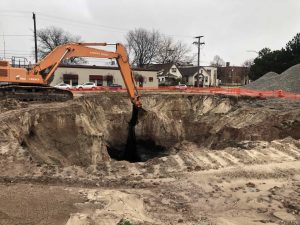
The intervention eliminated hydrocarbon contamination across an area of 900 m² and reduced TPH concentrations to levels below the limits established by environmental regulations

We successfully completed the remediation of groundwater affected by a diesel spill that occurred in July 2021 at an oil facility in the Ecuadorian Amazon. The project was carried out by the Litoclean Peru team, who brought their expertise and specialized knowledge to this environmental remediation project.
The intervention, which we carried out through pump-and-treat between November 2022 and November 2024, eliminated the impacted plume and reduced dissolved TPH concentrations across the entire piezometric network to below the national reference value of 0.5 mg/l, with the results verified before the Ministry of Environment, Water and Ecological Transition (MAATE).
We started with a maximum concentration of 55.75 mg/l of dissolved TPH at the most affected point and successfully reduced it to levels below 0.3 mg/l, the analytical method detection limit, across the entire monitoring network. These results were supported by analyses carried out by a laboratory accredited by the environmental authority.
To achieve these objectives, we designed and implemented a groundwater pump-and-treat solution, adapted to the characteristics of the site and aimed at both extracting the affected water and managing the recovered hydrocarbons.
More than 1,150 m³ of groundwater treated
During the operation, we extracted and treated 1,154.48 m³ of groundwater. To do so, we installed submersible pumps in 8-metre-deep extraction piezometers, allowing us to control the extraction process and convey the water to the treatment system.
During the initial stages of the work, we also detected free-phase hydrocarbons. We recovered them and directed them to the treatment system, with no further free-phase hydrocarbons detected during the remainder of the operation.
The solution allowed us to directly address the affected groundwater and make controlled progress towards the remediation objectives established for the site.

A monitoring network to track every stage of the remediation
To assess the progress of the remediation, we established a monitoring network consisting of 10 piezometers, where we periodically monitored groundwater levels and quality.
Dissolved TPH was the main parameter used to assess the evolution of the contamination. Through analytical monitoring, we were able to track the progressive reduction in concentrations and verify compliance with the established objectives.
In addition, we verified the quality of the extracted and treated water through analyses performed by an accredited laboratory before each discharge. This allowed us to ensure the traceability and control of the entire remediation process.

Technology and expertise applied to environmental remediation
The selection of a pump-and-treat approach allowed us to directly address the groundwater contamination, combining controlled extraction with continuous monitoring of the evolution of the impacted plume.
Throughout the project, we adapted the operation based on the results obtained at each stage, using the information provided by the monitoring network and laboratory analyses as a basis for decision-making.
For us, this project is an example of how technical expertise, remediation experience and analytical monitoring can be integrated to address complex environmental challenges and achieve measurable and verifiable results.

A new milestone in Ecuador
The completion of this intervention represents our first remediation project carried out in Ecuador and marks an important step in the development of our environmental remediation activities in the country.
The results achieved — 900 m² of affected area, 1,154.48 m³ of groundwater extracted and treated, and a reduction in dissolved TPH from 55.75 mg/l to levels below 0.3 mg/l — demonstrate the effectiveness of the solution implemented and compliance with the established remediation objectives.
This project also provides us with valuable experience for future interventions at hydrocarbon-impacted sites, both in Ecuador and in other locations with similar environmental and operational conditions.
Through this intervention, we reinforce our commitment to the remediation of contaminated sites and the protection of natural resources, placing technology and specialized expertise, together with the experience of our teams across Latin America, at the service of effective and sustainable environmental solutions.