
Passive VOC and NOx degradation
Photocatalysis is a chemical reaction that removes pollutants commonly found in the atmosphere, such as VOCs, NOx and SOx through an oxidation process activated by solar energy.
The most commonly used photocatalyst is titanium dioxide(TiO2).


Photocatalysis
Decomposition of contaminants


Product test
Litoclean has subjected the product to exhaustive tests developed and controlled at the Fraunhofer Institute in Germany, which have yielded promising and decisive results that endorse the veracity of the action of the photocatalysis process offered by the product.
Application of a constant flow of air with Toluene and another with Formaldehyde in a closed receptacle, primed with TiO2 nanoparticles and ultraviolet light.
Toluene concentration vs. time curve.

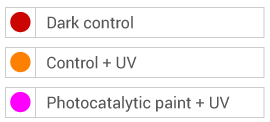
67.4% VOC removal by photocatalysis
No accumulation of toluene degradation products (formaldehyde, acetaldehyde, formic acid, acetic acid, acrolein, ethanol and other semi-volatile VOCs ) is observed, so their total elimination is affirmed.

The complete degradation of toluene would be confirmed.
1,000 ppb Toluene +Photocatalytic paint + UV = ~ 3 ppm CO2
Formaldehyde concentration vs. time curve.

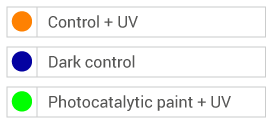
57.3% VOC removal by photocatalysis
No accumulation of the degradation products of formaldehyde (acetaldehyde, formic acid and acetic acid) is observed, so their total elimination is affirmed.
Formaldehyde + Catalyst product + UV = ~ CO2 + Water
Removal of VOCs present in the atmosphere by
photocatalysis.
Solutions for:
How do we help the industry?
Application
Water-based paint
Titanium dioxide
in nanoparticles
Nebulization
of the product
Any surface
Generates environmental improvement
In the presence of sunlight
or UV rays.